Swords · Four · Air
Four of Swords
- rest
- recovery
- retreat
- stillness
A deliberate rest; stepping back from the noise so your mind can settle and recover.
Upright
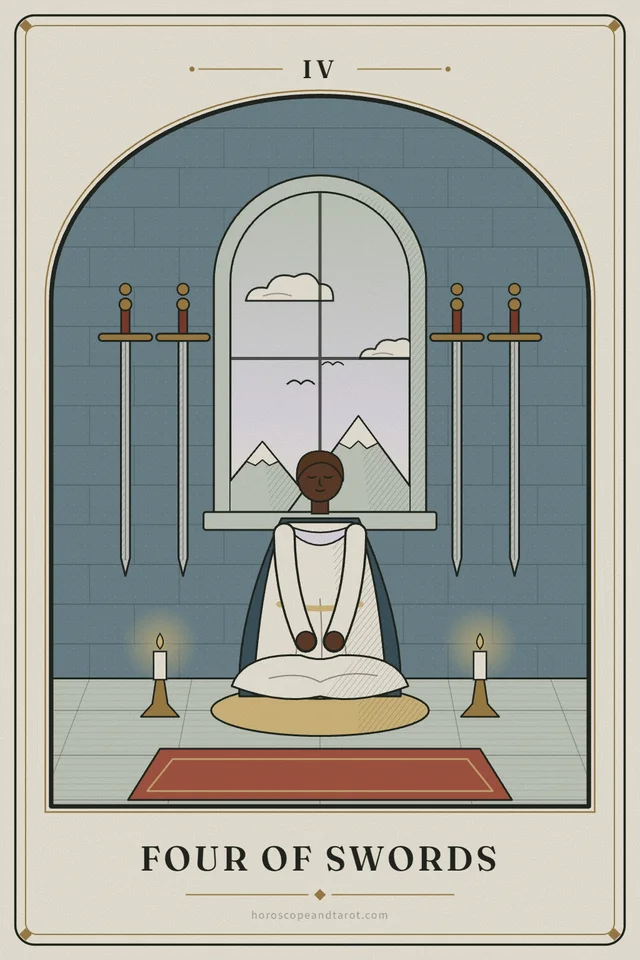
The Four of Swords is a card of rest. Fours often represent stability in tarot, and in the restless suit of Swords that stability comes from stopping. Traditionally it shows a knight lying in repose in a quiet chapel, one sword beneath him and three on the wall above. It signals recuperation, retreat, contemplation and a deliberate pause after strain.
In everyday life, this card might appear after a stressful stretch at work, a difficult conversation or a period of heavy thinking. It’s a reminder that minds need rest as much as bodies do. That might mean a proper weekend off, a nap, an evening without screens, or just ten quiet minutes between meetings. The four isn’t about giving up. It’s about recovering so you can think clearly again. Rest is productive in its own way; it’s when the sword gets resharpened.
Reversed
Our draws are upright-only by default; some readers use reversals as a quieter, inward or blocked version of the card.
Reversed, the Four of Swords suggests restlessness or a rest that’s overdue. You may be pushing through exhaustion, or feeling unable to switch off even when you have the chance. It can also point to the end of a retreat and a readiness to return. Ask honestly which it is, and give yourself the kind of break you actually need.
Four of Swords in love
A pause to recover: space after conflict, rest after a breakup, a quieter stretch for a couple.
Reversed in love: Restlessness after a pause, or rejoining before you’ve really recovered.
Draw it in a love tarot reading: you, them and the connection.
Is Four of Swords a yes or no card?
Not yet The Four of Swords says rest first. Come back to it later. Reversed, it reads no.
Ask your own question in a yes or no tarot reading.
In a three-card spread
- What to notice
- Notice where mental strain has built up and is asking for a pause.
- What to release
- Release the guilt that comes with stopping.
- What to practice
- Practice deliberate rest and quiet reflection as part of your routine.
Symbolism
The Four of Swords traditionally shows the effigy of a knight lying on a tomb in a church, hands folded in prayer. Three swords hang on the wall above him, pointing down, and a fourth lies along the side of the tomb. A stained-glass window shows a figure with a kneeling supplicant. Themes include repose, retreat, recuperation, contemplation and peace after struggle.