The crescent moon symbol stands, first of all, for the Moon itself, and by extension for change, growth and cycles, since a crescent is the Moon on its way to full or on its way out. It is one of the oldest symbols people have drawn: crescents appear on Mesopotamian cylinder seals more than four thousand years old, linked to the moon god Nanna, also called Sin. Since then it has stood for goddesses, cities, empires, the Virgin Mary and silver, and today it is widely recognized as an emblem associated with Islam, though it isn't a religious symbol in Islamic scripture.
Which way it faces, and why that matters
A real crescent's shape tells you where the Moon is in its cycle. From the Northern Hemisphere, a crescent lit on the right, with its horns pointing left, is a waxing crescent, seen in the west after sunset and growing toward first quarter. A crescent lit on the left, horns pointing right, is a waning crescent, seen in the east before dawn and shrinking toward new moon. In the Southern Hemisphere it's the other way round, and near the equator crescents tip over and lie almost flat, like a bowl.
Symbol-makers rarely worry about astronomy, and the crescent on a flag or a pendant can point either way. But in modern spiritual use the direction often carries meaning:
- Horns to the left (waxing, in the north): growth, beginnings, intentions, things gathering strength.
- Horns to the right (waning, in the north): release, endings, rest, letting go.
- Horns up, like a cup or a boat: sometimes read as receptivity, holding or gathering.
Our guide to waxing vs waning moons has more on telling the real phases apart, and moon phases in order walks through the whole cycle.
The crescent in the ancient world
The earliest crescents belong to the moon god of Mesopotamia, called Nanna in Sumerian and Sin in Akkadian, whose great temple stood at Ur. His crescent was carved on cylinder seals and boundary stones, often alongside the star of Inanna, or Ishtar, and the sun disc. The Egyptian hieroglyph for the Moon was a crescent too.
In the Greek and Roman world, the crescent became a mark of lunar goddesses. Selene, the Moon personified, was shown with a crescent on her head, and in the Hellenistic period the crescent became a symbol of Artemis, the Roman Diana. Hecate, a goddess of crossroads and the night, came to be shown in triple form, and the philosopher Porphyry, in the third century AD, linked her three aspects with phases of the Moon. A star and crescent was also the emblem of the city of Byzantium, long before the city became Constantinople and, later, Istanbul.
The crescent, the star and Islam
The crescent has a natural place in Islamic life because the Islamic calendar is purely lunar. Each month begins with the first sighting of the new crescent, the hilal, in the evening sky, which is why the start of Ramadan depends on the Moon. We explain how that calendar works in our guide to the lunar calendar.
As a symbol, though, the crescent's association with Islam came later and more gradually than many people assume. It appears in some early Islamic art, but scholars generally date its widespread use as an emblem to the later Middle Ages, and the familiar star and crescent spread with the Ottoman Empire, whose flags carried it. Through the twentieth century, as former Ottoman lands and other Muslim-majority countries chose national flags, it appeared on many of them, including those of Turkey, Pakistan, Algeria, Tunisia and Malaysia. The Red Crescent, used in place of the red cross by humanitarian societies in many Muslim-majority countries, dates back to the Russo-Turkish War of the 1870s.
Many Muslims don't treat the crescent as a religious symbol at all, since the Quran doesn't present it as one, and some reject it as an emblem of faith. It's fairer to call it a cultural and national symbol widely associated with Islam than a sacred one.
Mary and the moon under her feet
Christian art has its own crescent. The Book of Revelation describes "a woman clothed with the sun, and the moon under her feet, and upon her head a crown of twelve stars," and artists came to read that figure as the Virgin Mary. Many paintings and statues of Mary, particularly of the Immaculate Conception, show her standing on a crescent moon, and the famous image of Our Lady of Guadalupe in Mexico shows her standing on a dark crescent held up by an angel.
Some Russian Orthodox churches crown their domes with a cross rising from a crescent, a design that goes back to medieval Russia and has nothing to do with Islam.
Heraldry, alchemy, astrology and tarot
The crescent turns up across Europe's older systems of signs:
- Heraldry. In English heraldry, a small crescent added to a coat of arms marks a second son, one of the traditional "marks of difference" used to tell brothers' arms apart.
- Alchemy. The crescent was the symbol for silver, the Moon's metal, as the Sun's circle stood for gold.
- Astrology. The glyph for the Moon in a birth chart is a crescent, and astrologers read the Moon as the part of you that feels, needs and remembers. If you've never looked up your own, a moon sign calculator will tell you where it was when you were born.
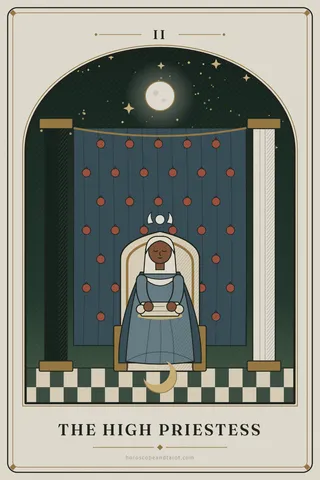
- Tarot. In the classic Rider-Waite-Smith deck, a crescent moon lies at the feet of The High Priestess, the card of intuition and things not yet revealed, and she wears a horned lunar crown. The Chariot's driver has crescent moons on his shoulders.
The triple moon and modern meanings
One of the most popular crescent designs today is the triple moon: a waxing crescent, a full circle and a waning crescent side by side. In modern pagan and Wiccan practice it stands for the Triple Goddess, shown as Maiden, Mother and Crone, matched to the waxing, full and waning Moon. The symbol looks ancient, but that particular framing is modern. The poet Robert Graves made the Maiden, Mother and Crone idea famous in his 1948 book The White Goddess, and the historian Ronald Hutton has described it as Graves's own creation rather than something found in ancient sources.
Outside religion, people wear crescents for reasons of their own. As a tattoo or a pendant, a crescent moon is commonly chosen to mean:
- Change and growth, because the Moon is always between phases.
- New beginnings, after the first crescent that follows the new moon.
- Intuition and the inner life, after the Moon's role in astrology and tarot.
- Femininity, after the long line of lunar goddesses.
- Resilience, the idea that something dark comes back into the light every month.
None of those is the one true meaning. A symbol this old has carried them all, and the meaning that matters is the one you give it.
Questions readers ask
What does a crescent moon tattoo mean?
Most often change, growth and new beginnings, since a crescent is the Moon between phases. Many people also choose it for intuition, femininity or a personal connection to the night sky. A waxing crescent is often read as growth and a waning one as release.
What does the crescent moon and star mean?
It has meant different things in different eras. It was an emblem of ancient Byzantium and of the Mithridatic kings of Pontus, and later of the Ottoman Empire, which is why it appears on many national flags today. It's widely associated with Islam, but many Muslims don't consider it a religious symbol.
Is the crescent moon a symbol of Islam?
It's widely associated with Islam, largely through its use by the Ottoman Empire and on the flags of many Muslim-majority countries. It isn't a religious symbol in the Quran, and some Muslims reject it as one, so it's best described as a cultural symbol linked with Islam.
What does a crescent moon mean spiritually?
In modern spiritual practice, a waxing crescent usually stands for intentions and growth, and a waning crescent for release and rest. It's also linked with intuition and the cycles of life. Those are interpretations rather than fixed rules, so take what fits your own practice.
